a special interest group of the Library Association of Ireland committed to promoting awareness of and expertise in all aspects of library resource description.
Author: laicmg
LAI Cataloguing and Metadata Group
- a special interest group of the Library Association of Ireland committed to promoting awareness of and expertise in all aspects of library resource description.
In RDA Improvers / Refreshers Day, Anne Welsh will look at some examples of more complex publications, such as related works (films of books and soundtracks from films, for example).
We’ll also look at versioning and the way that some works are combined and recombined with others. In old money (AACR2) we often dealt with these using a combination of contents notes (MARC 505), added entries (700 author / title / 730 added uniform title / 246 alternative title) and analytical entries (MARC 740).
The good news continues to be that if we are working in a MARC environment or a non-MARC LMS that is not BIBFRAME, we can still use these solutions. However, in response to community needs, RDA provides a different way to consider this issue conceptually, which once we are eventually working in a BIBFRAME or other Linked Data cataloguing environment should allow us to reap new rewards.
We will also discuss where your institutions are with the move to Official RDA and look at some of the things to consider if you are moving towards implementation.
This training is suitable for those who attended LAI CMG’s RDA 2026 training or earlier trainings, or for those already familiar with the basics of RDA (how to catalogue monographs with straightforward titles, authors and edition statements). You do not need to know MARC or AACR2 since we will be working in MARC on paper / a Word document, but where there is a process that relates to older Anglo-American procedures, the trainer will refer to them in passing for the benefit of those who have catalogued in AACR2.
An introduction to the Code of Ethics: principles and values that provide an intentional decision-making framework for cataloguers on 26 Feb 2025 17:30 National Library of Ireland
Wed, 26 Feb 2025 17:30 – 19:30 GMT
Richard Hayes Room, National Library of Ireland, Kildare Street, Dublin 2
Tickets are free and available on eventbrite here on a first come first served basis.
The Library Association of Ireland Cataloguing and Metadata Group (LAICMG) are delighted to host their 2024 AGM in the the National Library of Ireland NLI preceded by a keynote by Jane Daniels on an introduction to the topic of the ongoing work of the Cataloging Ethics Steering Committee.
The Cataloguing Code of Ethics was created by the Cataloging Ethics Steering Committee, consisting of members from cataloguing communities in the United States, Canada, and the United Kingdom, with the assistance of Working Group members from the international cataloguing community. The document is a community response to clearly articulated needs for a code of ethics addressing the specific responsibilities of cataloguers and metadata managers engaged in creating, sharing, enriching and preserving metadata in an increasingly global and technology dominated cataloguing ecosystem.
“The term cataloguing ethics is defined as a set of principles and values that provide an intentional decision-making framework for those who work in cataloguing or metadata positions. A subset of critical librarianship, critical cataloguing focuses on understanding and changing how knowledge organisations codify systems of oppression.
Metadata creation is an ongoing process involving work that is wide-ranging, collaborative, and in a constant state of change. Tension between change and status quo creates opportunity to confront ethical issues within our community of practice.
As cataloguers, we have significant influence over how information resources are represented through the choices we make. This ethics document provides a framework for approaching cataloguing work that will be a useful tool for practitioners, employers, standards’ developers, vendors, students, and educators when ethical situations arise”
– cataloguing Code of Ethics
For more information:
Chan, M., Daniels, J., Furger, S., Rasmussen, D., Shoemaker, E., & Snow, K. (2022). The Development and Future of the Cataloguing Code of Ethics. Cataloging & Classification Quarterly, 60(8), 786–806. https://doi.org/10.1080/01639374.2022.2134247
Jane Daniels was Bibliographic Librarian at Cardiff Metropolitan University until her retirement in April 2022. She catalogued a range of resources and also managed metadata received from system, content and service providers. She was also a member of the WHELF (Wales Higher Education Libraries Forum) Cataloguing & Metadata Group; the Jisc NBK Phase 2 Task & Finish Group for Metadata Quality & Standards – Plan M; and the Ex Libris Community Zone Management Group.
Jane Daniels is an active member of the Joint USA, Canadian & UK Cataloguing Ethics Steering Committee, who, working with the cataloguing community of practice, produced the Cataloguing Code of Ethics in 2021. Jane is the past Chair (2018-2020) of the CILIP Metadata & Discovery Group (previously the Cataloguing & Indexing Group.) Since retirement Jane has become a volunteer at her local museum and has become an advocate for the adoption of the Code in the wider cultural sector.
The keynote will be followed by the LAICMG AGM (members only), and an opportunity to network with refreshments
Tickets are free and available on eventbrite here on a first come first served basis.
Are you new to cataloguing, or returning to it after a break? Join the LAICMG online on 27th February to dive into cataloguing with Anne Welsh
Save the date 27th February, 2025.
Tickets can be booked on our eventbrite page here and student LAI members can avail of a special discount price subsidised by the LAICMG.
Due to demand, the LAICMG will be hosting a re-run of the Fundamentals of Cataloguing online workshop (held in October 2024).
Guided by trainer Anne Welsh (Beginning Cataloguing), we’ll consider first principles (what we are really doing when we catalogue); the language of cataloguing (basic jargon-busting); and subject analysis (the aboutness of the thing in our hands). In practical terms, we’ll create basic records (in a Word document or in our notebooks) for three related works, including FAST subject headings. We’ll also consider the tricky bits of some other books that have quirky but not uncommon elements affecting how we describe their title, extent, illustrations and inserts. We’ll look at how we make sure that the names of their creators are entered consistently (Name Authority control) and that they receive the correct subject headings (FAST).No knowledge of MARC or RDA is required (cheat sheets will be provided) and no pre-existing knowledge of how to catalogue is needed – if you can search your own catalogue, this training will provide you with the fundamentals to understand how the cataloguer decided what to put on the catalogue in the first place
Learning outcomes
This course is in response to a stated demand for practical training in Cataloguing. By the end of the day, participants will be able to:
Describe what cataloguing is, why it matters and the basic principles that underpin it
Create several records that include the fields and subfields commonly expected by libraries / cataloguing agencies
Look up authorities.loc.gov (a free resource provided by the Library of Congress) to establish the name headings for several creators (MARC 1XX) and co-creators (MARC 7XX) and have an awareness of the different ways that Library Management Systems handle Name Authority, so they can check which is in use at their workplace / place of study
Establish FAST subject headings using subject analysis skills
Demonstrate beginner-level experience in cataloguing using the main cataloguing standards
Look for further information to extend their skills and keep them up-to-date using resources shared on the coure.
These Teaching and Learning Objectives contribute to an overarching Aim, which is that as many people as possible who are responsible for creating library metadata should have the confidence to employ what is commonly referred to in the literature as “cataloguer judgement” – i.e. the confidence to know which standards and rules to employ, where and when to look them up, and the ability to interpret and apply them.
Tickets on eventbrite
Tickets can be booked on our eventbrite page here and student LAI members can avail of a special discount price subsidised by the LAICMG.
Please note that places on this course are confined to staff and students based in Ireland
Tickets are limited. We look forward to seeing some of you on the day.
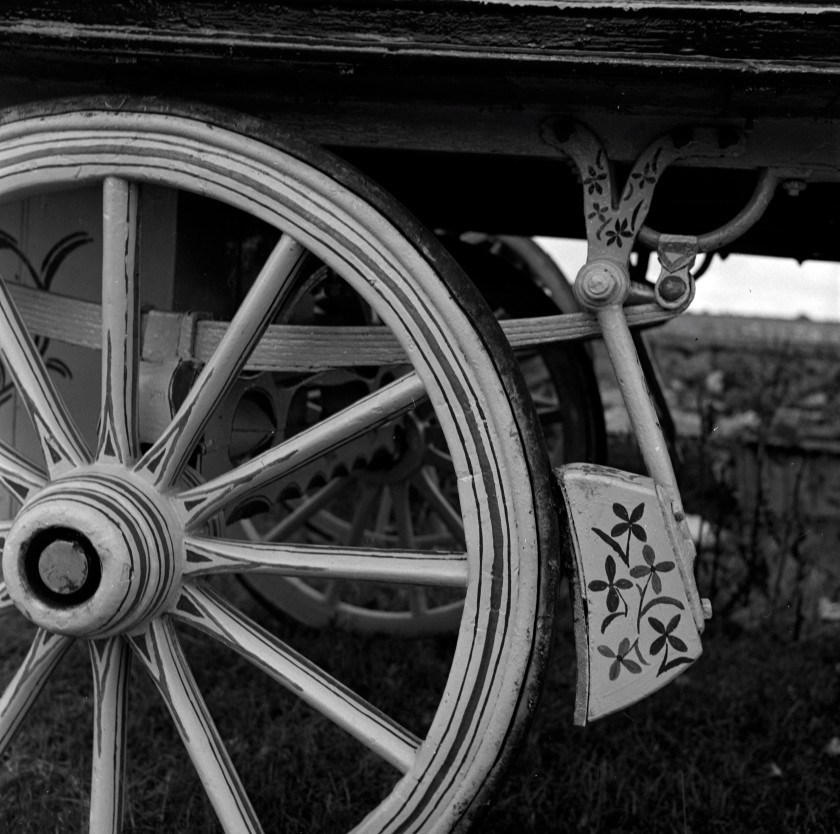
Detail of Caravan Wheel, Buttevant, Co. Cork. 1954 from The Wiltshire Photographic Collection Reproduced courtesy of the National Library of Ireland.
The LAICMG are pleased to announce that their proposal to add a specific class number for Irish Travellers/Mincéirí to the Dewey Decimal Classification system was successful.
Irish Travellers are a distinctive ethnic community based primarily in Ireland. However, throughout their history they have experienced widespread discrimination, exclusion, and stereotyping. This fact was somewhat reflective in the DDC, as Irish Travellers were not specifically mentioned in previous editions of Dewey and so works on this indigenous group were often misclassified.
The project proposal for the new numbers was approved by the Dewey Editorial Policy Committee in August 2023, following months of hard work by LAICMG committee members, led by Dean Waters (Assistant Librarian, Griffith College, Dublin) and Ruth O’Hara (Assistant Librarian, Maynooth University). Work on the process included collating lists of publications to establish sound ‘literary warranty’ and putting together a solid proposal which involved consultation with key stakeholders, including Irish Traveller representative groups, library colleagues and academics.
The new changes are as follows:
A new subdivision especially for Irish Travellers (Mincéirí) at T5—91623 Irish Travellers (Mincéirí), under T5—9162 Irish.
Add the resulting built numbers for Irish Travellers in sociology (305.891623) and history (941.500491623) to WebDewey.
The LAICMG was in attendance at IFLA WLIC 2022 . The post below was written by the CMG secretary, Patricia Moloney regarding some of the various cataloguing, metadata and bibliography related sessions.
Quality Control for Metadata: What Does it Mean?
On Tuesday, July 26, 11:00 – 12:15, IFLA’s Cataloguing Section’s panel of selected metadata experts discussed current issues surrounding the quality of metadata in the library sector, and its management. The session covered topics such as policy management, the available tools for managing quality control, and the best ways to measure quality. Following these presentations, the panel took questions from the audience.
OCLC Industry Symposium: Working with a Metadata Mindset
On Tuesday afternoon, July 26, 14:45 – 16:00, following opening remarks by OCLC President and CEO Skip Prichard on OCLC priorities and progress on major library initiatives for the coming year, Lorcan Dempsey, recently retired Chief Strategist for OCLC, delivered a presentation on the work of OCLC Research to use global WorldCat bibliographic and holdings data to explore national contributions to the published record, drawing on insights from Ireland. Mary Sauer-Games, OCLC Vice President, Global Product Management, spoke about the value of the OCLC infrastructure to connect and enrich a growing network of libraries which represent the collective data, resources, and expertise of thousands of libraries. Axel Kaschte, Director Product Strategy EMEA, ended the session with an update us on WorldCat Entities, a new linked data infrastructure that represents a landmark for libraries.
National Bibliographies Today: Common Practices, Shared Perspectives
Wednesday morning, July 27, 08:30 – 10:00 began early with a session on national bibliographies. Following opening remarks by the chair, Mathilde Koskas, (Bibliothèque nationale de France), the participants broke into groups and discussed the recently updated Common Practices for National Bibliographiesnewly published in June 2022, (the result of 5 years of work), by members of the IFLA’s Bibliography section past and present. Its predecessors were the web publication, Best Practice for National Bibliographic Agencies in a Digital Age (2014-2017) and the original printed National Bibliographies in the Digital Age: Guidance and New Directions (2009), (2008 draft available here). Closing remarks were by Pat Riva (Concordia University). This session’s discussion outcomes will become part of the new cycle of development of the Common Practices, in response to fast-paced changes in actors, technologies and cataloguing standards.
Later on Wednesday afternoon, 15:30 – 17:30, the Bibliographic Conceptual Models Review Group invited attendees to discuss the latest draft of LRMoo. The Bibliographic Conceptual Models Review Group (BCM RG) provides ongoing support for the maintenance and development of the IFLA bibliographic conceptual models. The BCM Review Group reports to the IFLA Committee on Standards. The IFLA Library Reference Model (IFLA LRM) was approved as an IFLA standard in August 2017. IFLA LRM consolidates and succeeds the three models in the IFLA FR family of conceptual models (FRBR, FRAD, FRSAD). FRBRoo version 2.4, approved as an IFLA standard in 2016, reflected the three IFLA entity-relationship models in a formulation designed as a compatible extension to the museum community’s model, the CIDOC Conceptual Reference Model (CIDOC CRM). The role of the LRMoo model is to provide a similar equivalent for IFLA LRM which was developed to resolve inconsistencies between the three separate models. Every user task, entity, attribute and relationship from the original three models was examined, definitions had to be revised, but also some remodelling was required in order to develop a meaningful consolidation. The result is a single, streamlined, and logically consistent model that covers all aspects of bibliographic data and that at the same time brings the modelling up-to-date with current conceptual modelling practices. IFLA LRM was designed to be used in linked data environments and to support and promote the use of bibliographic data in linked data environments.
Defining the National Collection: Challenges and Opportunities Found at the Intersections of the Future and the Past
This open session on Thursday morning 11:15 – 12:45, which was chaired by Liisa Savolainen, National Library of Finland, Finland and moderated by Robin Dale, Library of Congress, United States, gave attendees an opportunity to explore the elements that shape the national collection, as well as the questions many national libraries are asking themselves as they seek to identify and address challenges and opportunities today and into the future. Following the video presentations (above) the participants formed breakout groups to facilitate discussions, to share feedback on the presentations and to explore the elements that shape the national collections in their countries.
The ongoing work of Media Literacy Ireland with key stakeholder the Library Association of Ireland and how LAICMG members can get involved.
About this event
The Library Association of Ireland Cataloguing and Metadata Group (LAICMG) are delighted to be hosting their 2021 AGM on 17 Feb 2022 in the gorgeous surroundings of the Museum of Literature, Ireland (MoLI ) preceded by a keynote by Isabelle Courtney on the topic of the ongoing work of Media Literacy Ireland (MLI).
Media Literacy Ireland is an informal alliance of organisations and individuals working together on a voluntary basis to promote media literacy in Ireland. The Library Association of Ireland (LAI) is a key stakeholder in this initiative and in her presentation, Isabel Courtney will outline the work to date and suggest ways in which LAICMG members can get involved.
Isabelle Courtney is a librarian and freelance journalist. She lectures in Records Management and Information Law on Library & Information Management MSc programme in Dublin Business School. She has a particular interest in Information and media literacy, knowledge and records management. She is passionate about libraries and has a love of the concept of lifelong learning and self-development. She is a member of the Library Association of Ireland (LAI) where she sits on the Career Development Group and Literacies Committee and facilitated the collaboration between the LAI and Media Literacy Ireland (MLI).
The keynote will be followed by an opportunity to network with refreshments and a complimentary tour of MoLI and the LAICMG AGM (members only)
Date and time
Thu, 17 Feb 2022, 16:00 GMT
Tickets are free of charge but numbers are limited. Please register on eventbrite here
Please note that, in line with government guidelines, all visitors must wear a face covering.All of the above arrangements are dependent on public health restrictions. The number of attendees will be limited to 25. Tickets are free and available on a first come first served basis
Schedule :
4:00 Registration,
4:15 Welcome;
4:30 Keynote;
5:00 Q&A
5:15 AGM;
5:30 Networking with refreshments and tour of MoLI
Due to the high level of interest in our recent workshop on getting started in rare book cataloguing, held on Friday 2nd July, the LAICMG will be running a repeat workshop on the 3rd September, 2021.
This online workshop will take place over Zoom. Participants will have to be able to switch between Zoom and other applications, especially to read PDF documents; for this reason joining by tablet (such as iPad) is not recommended.
A zoom link will be sent (from laicmgsec[at]gmail.com) to those registered close to the date of 3rd of September. Please check your spam folders.
At the end of this one-day bespoke workshop participants will leave having catalogued three rare books and with knowledge of where to seek further information.
This course has been certified by the Library Association of Ireland Continuing Professional Development Committee. Certificates of attendance will be issued to attendees.
The workshop level is suitable for students or staff with some general cataloguing experience or as a refresher course. For further information and to register see: https://laicmgrarecat.eventbrite.ie/
Booking is via eventbrite only, and tickets are available on a first come, first served basis.
The three books we will catalogue represent three common periods held by many special collections:
One Early Modern book
One 18th century book
One modern (post-1950) book with features that make rare book cataloguing appropriate.
Model answers will be provided in:
DCRM(B) in MARC
RDA in MARC
AACR2 in MARC
A month before the training, you will receive four PDFs:
an introductory reading list
a summary of the relevant MARC fields we’ll be using on the day
‘The vocabulary of rare books’ – a basic glossary of common terms
a list of useful online sources
You don’t have to read anything in advance, but for those who do like to read ahead, these will be useful resources.
Please note that the majority of the places are reserved for current members of the Library Association of Ireland (LAI) at a discounted price. (Membership will be verified). In addition, a small number of places will be available to current LIS students/unwaged at a nominal price. See tickets for further details here: https://laicmgrarecat.eventbrite.ie/
Schedule for the day
10:00 – 10:15 am Welcome from the LAI CMG and Anne Welsh
10:15 – 10:30 am Introductions from participants
10:30 – 10:45 am What is rare book cataloguing and when do we use it? What makes it different from modern book cataloguing? What’s the same?
10:45 – 11:30 am Look and learn: main fields in use for cataloguing rare books
11:30 am –12:15 pm Example 1: an Early Modern text (practical cataloguing exercise)
12:15 – 1:45 pm LUNCH
1:45 – 2:00 pm What about copy-specific details?
2:00 – 2:15 pm Binding resources
2:15 – 3:15 pm Example 2: an 18th century text (practical cataloguing exercise)
3:15 – 3:30 pm Provenance resources
3:30 – 4:00 pm Example 3: a modern text with provenance information (practical cataloguing exercise)
4:00 – 4:30 pm Provenance at your library. What are your local practices? (You may find it helpful to have an example of a book with provenance marks e.g. marginalia, bookplates,book stamps, armorial bindings and its record from your library to help you contribute to the discussion).
4:30 – 5:00 pm General discussion; routes forward to learn more.
Anne Welsh has been cataloguing professionally since 1993 and teaching others to catalogue since 1995.
She first studied Bibliography as part of her undergraduate courses in English Language and Literature, and taught Historical Bibliography for over a decade.